Thymidine decreases the DNA damage and apoptosis caused by tumor‐treating fields in cancer cell lines
조회 1,499
Background
Tumor-treating fields (TTFields) is an emerging non-invasive cancer-treatment modality using alternating electric fields with low intensities and an intermediate range of frequency. TTFields affects an extensive range of charged and polarizable cellular factors known to be involved in cell division. However, it causes side-effects, such as DNA damage and apoptosis, in healthy cells.
Objective
To investigate whether thymidine can have an effect on the DNA damage and apoptosis, we arrested the cell cycle of human glioblastoma cells (U373) at G1/S phase by using thymidine and then exposed these cells to TTFields.
Methods
Cancer cell lines and normal cell (HaCaT) were arrested by thymidine double block method. Cells were seeded into the gap of between the insulated wires. The exposed in alternative electric fields at 120 kHz, 1.2 V/cm. They were counted the cell numbers and analyzed for cancer malignant such as colony formation, Annexin V/PI staining, γH2AX and RT-PCR.
Results
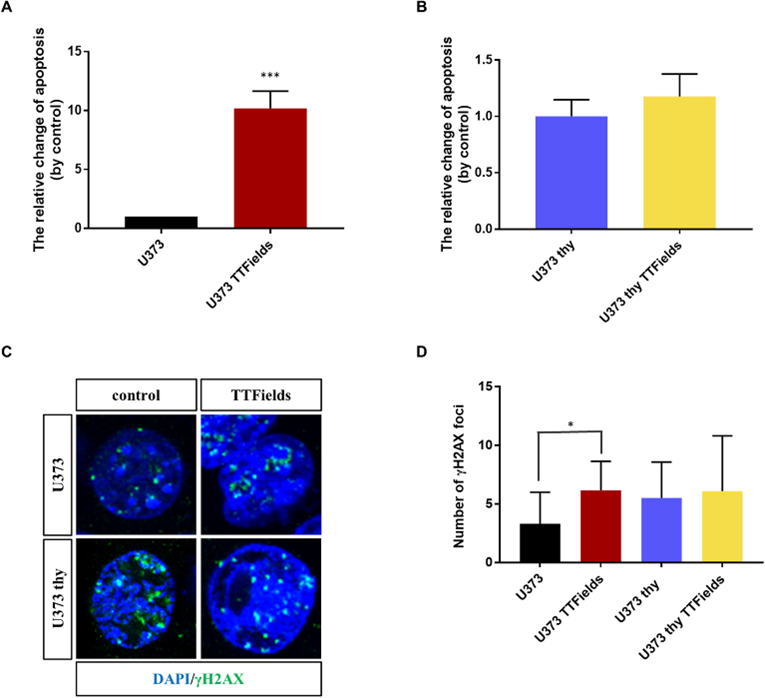
The colony-forming ability and DNA damage of the control cells without thymidine treatment were significantly decreased, and the expression levels of BRCA1, PCNA, CDC25C, and MAD2 were distinctly increased. Interestingly, however, cells treated with thymidine did not change the colony formation, apoptosis, DNA damage, or gene expression pattern.
Conclusions
These results demonstrated that thymidine can inhibit the TTFields-caused DNA damage and apoptosis, suggesting that combining TTFields and conventional treatments, such as chemotherapy, may enhance prognosis and decrease side effects compared with those of TTFields or conventional treatments alone.
Hyesun Jeong, Sunghoi Hong
School of Biosystems and Biomedical Sciences, Korea University, 145 Anam-ro, Seongbuk-gu, Seoul, 02841, Republic of Korea
Hyesun Jeong, Sunghoi Hong
Department of Public Health Science, Korea University, 145 Anam-ro, Seongbuk-gu, Seoul, 02841, Republic of Korea
Yunhui Jo, Myonggeun Yoon
Department of Bio- Convergence Engineering, Korea University, 145 Anam-ro, Seongbuk-gu, Seoul, 02841, Republic of Korea
Genes Genom 43, 995–1001 (2021)